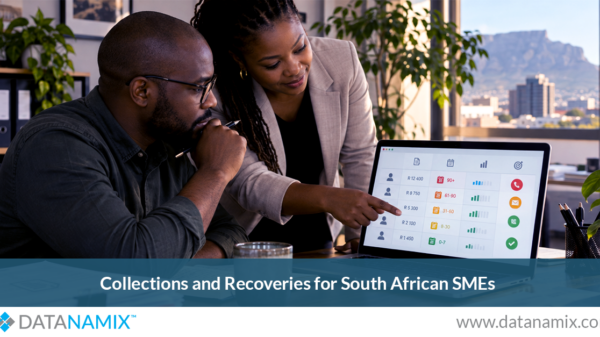






Collections and Recoveries for South African SMEs
Collections and Recoveries for South African SMEs begins with a practical question: where should a limited team spend its attention first? An overdue-account list shows who owes money and how long an amount has been outstanding. It does not always show whether the customer can be contacted, whether key details are current or what the most appropriate next review step should be.
Collections and Recoveries for South African SMEs therefore needs more than a queue ordered by balance or age. It needs a consistent way to review available customer and account information, make gaps visible and assign work according to the SME’s own policy. Information supports that prioritisation. It does not make the decision on the business’s behalf.
An overdue-account list is not yet a work plan
Consider an illustrative SME with a small finance team. At the start of the day, the collections manager has dozens of overdue accounts, several returned messages and limited time for follow-up. The account with the largest balance draws attention first, but the manager still needs to know whether the contact information is usable, whether the account details are correct and whether previous engagement affects the next step.
The largest balance may be important, but no single field explains the whole case. Days overdue, balance, contactability, account history and the status of previous actions answer different questions.
The purpose of review is to turn the list into work that someone can perform and explain.
Define what prioritisation means for the business
Before adding information, the SME should define its own prioritisation rules. One business may focus first on high-value accounts. Another may begin with recent arrears where early engagement is part of its policy. A third may separate accounts with missing details from accounts ready for contact.
The important point is that the rule belongs to the SME. It should reflect the business’s contracts, customer circumstances, legal requirements, resources and collections strategy.
A useful framework can distinguish between:
- accounts ready for the next approved contact step;
- accounts where contact or identity details need checking;
- accounts requiring document or balance confirmation;
- accounts affected by a dispute, legal process or other restriction; and
- accounts that require a manager’s review before further action.
This is not a universal priority order. It is a way to stop different questions from being mixed into one undifferentiated queue.
Use information to answer the next question
The best information is the information needed for the next authorised action.
If a message has been returned, updated contact information may be relevant. If banking details need to be confirmed for an agreed payment arrangement, an appropriate verification step may help. If the account is linked to consumer credit, the business may need to consider credit information and its obligations under the applicable framework. If a record contains inconsistencies, the right next step may be internal review rather than customer contact.
Information should be interpreted in context. A contact detail does not prove that contact is appropriate. A credit record does not determine the tone or timing of an engagement. A trace result does not establish ability or willingness to pay.
Preserve ownership of the decision
Collections prioritisation involves commercial, operational and legal judgement. The SME decides which account receives attention, which action is permitted and when a matter needs escalation.
That boundary should be visible in the workflow. A data source may return information. A team member assesses it. The SME applies its policy and records the next step. Keeping those roles separate prevents an information result from being mistaken for an instruction.
It also makes review easier. A manager can see why an account was placed in a particular work group, what information supported the decision and which question remains unresolved.
Handle South African customer information with care
Collections work can involve personal information. Under the Protection of Personal Information Act, a responsible party must take reasonably practicable steps to ensure personal information is complete, accurate, not misleading and updated where necessary, taking account of the purpose for which it is processed.
The National Credit Act also regulates consumer-credit information and related credit-market activity. Its application depends on the customer, agreement and activity involved. SMEs should apply their own legal and compliance requirements rather than treating a data check as permission for a particular collections action.
Good information governance is part of the collection process: use information for a defined purpose, restrict access, record the source and avoid retaining or acting on information without the required basis.
How Datanamix supplies information for collections review
Datanamix Collections and Recoveries provides information services that can support an SME’s review process. The published solution includes Trace Reports, the Collections 360 dashboard, bank-account verification, batch analysis and default-listing services.
Trace Reports are intended to assist with locating or contacting customers. Collections 360 presents information for a collector or recovery agent in a dashboard. Bank verification can check the relationship between identity and account details. The relevant service depends on the question the SME is permitted and needs to answer.
Datanamix does not prioritise the SME’s accounts. It does not assign the collections queue or choose the recovery action. It supplies information that the SME can consider alongside its own account records, customer engagement history, policies and legal obligations.
Turn information into an explainable next step
A practical account-review process asks:
- What is the current status of the account?
- What question must be answered before the next action?
- Which information is relevant and lawful for that purpose?
- What remains uncertain or needs escalation?
- Who is responsible for deciding and recording the next step?
For an SME with limited collections capacity, the aim is not to create a perfect score for every account. It is to give the team enough relevant context to apply the business’s strategy consistently and keep control of the decision.
Explore Datanamix Collections and Recoveries to discuss which information services fit your account-review process.