





How can you assess business credit risk without paying for a full credit report every time?
Every lender, supplier, insurer, and credit provider faces the same challenge: understanding risk before making a decision. Assessing credit risk is a critical part of responsible business practices, but running a full credit report on every business that applies for a loan can quickly become expensive.
For organisations processing large volumes of applications or evaluating multiple business relationships, the cost of conducting a detailed credit assessment each time can add up significantly. At the same time, making decisions without any visibility into potential credit risk is not an option.
The challenge is finding a way to gain an initial understanding of a business’s credit profile before investing in a comprehensive assessment.
Why traditional business credit assessments can become expensive
A detailed business credit report provides valuable information about a company’s financial standing, payment behaviour, and overall risk profile. This information plays an important role in lending decisions, supplier agreements, insurance assessments, and other commercial relationships.
However, detailed reports come at a cost. Organisations that regularly assess businesses may find themselves spending significant amounts on comprehensive reports, particularly when dealing with large volumes of enquiries, applications, or potential business relationships. While the information remains valuable, there are situations where an initial indication of risk may be useful before committing to a full assessment.
The importance of understanding business risk early
Risk management is most effective when potential concerns are identified as early as possible. Before entering into a commercial relationship, extending terms, or progressing with a financing application, organisations benefit from understanding whether a business presents a relatively low, moderate, or higher level of risk.
An early credit risk indicator can provide valuable context during the initial stages of a decision-making process. Rather than relying solely on assumptions or limited information, organisations gain access to an objective view of potential risk factors before proceeding further.
This early visibility helps businesses approach opportunities with greater confidence and awareness.


How early risk visibility supports better decision-making
Every business decision involves a degree of risk. The more information available, the better equipped organisations are to make informed choices.
Having access to an early credit risk indication can help decision-makers understand the profile of a business before investing additional time, effort, and resources into a detailed assessment process. It can also provide useful context when comparing opportunities, evaluating new relationships, or reviewing applications.
Importantly, early risk visibility is not intended to replace detailed due diligence. Instead, it provides an additional layer of insight that supports more informed decision-making from the outset.
The benefits of a fast business risk indicator
Speed is often an important factor in commercial decision-making. Organisations frequently need to assess businesses quickly while maintaining appropriate risk management standards.
A fast credit risk indicator can provide an immediate view of potential risk without requiring a full report at the initial stage. This allows businesses to gain insight into a company’s risk profile within a short period of time while determining whether further investigation may be appropriate.
For organisations managing large portfolios, reviewing multiple applications, or assessing numerous business relationships, this can help improve efficiency while maintaining visibility into potential risk exposure.
Understanding risk before conducting a full credit assessment
There will always be situations where a comprehensive credit report is required. Detailed assessments provide the depth of information needed for underwriting, final approval processes, and more complex risk evaluations.
However, obtaining an early indication of risk before conducting a full assessment can provide meaningful value. It enables organisations to understand the overall risk profile of a business before progressing to more detailed investigations.
This layered approach allows businesses to build a clearer picture of risk over time, starting with an initial risk indication and progressing to a comprehensive assessment when deeper information is required.
A smarter way to gain early insight into business credit risk
Gaining visibility into business risk does not always require a comprehensive report as the first step. In many cases, organisations simply need an initial indication of potential risk before deciding to proceed with a more detailed assessment.
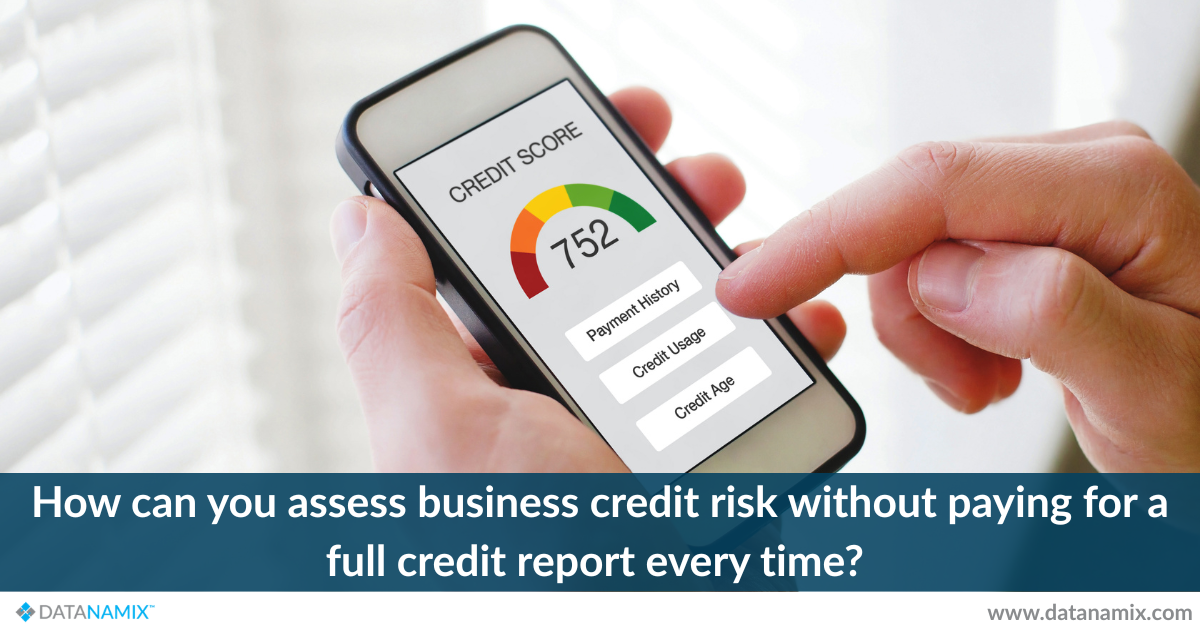
The Datanamix Business Express Credit Score was developed to provide this early insight. It delivers a fast indication of business risk by classifying businesses according to risk levels and highlighting potential concerns. This enables organisations to gain a clearer understanding of a business’s risk profile before obtaining a full credit report. The solution is available through the Datanamix platform and via API integration, making it easy for organisations to incorporate early risk screening into their existing workflows and systems.
The Datanamix Business Express Credit Score is not designed to replace a comprehensive credit assessment. Instead, it provides an additional layer of insight at the beginning of the process. Where a deeper understanding of a business is required, a full credit report remains an essential next step.
Understanding risk early helps organisations make more informed decisions, manage exposure more effectively, and approach business opportunities with greater confidence. By combining early risk visibility with detailed assessments when required, businesses can strengthen their overall approach to risk management while making the most of their assessment resources.
Contact us here to learn more.