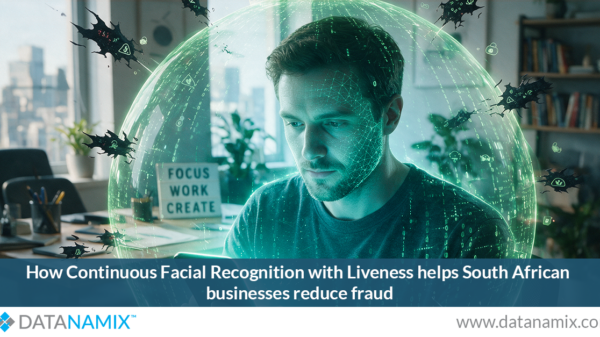





Continuous Facial Recognition with Liveness is a digital identity-assurance technology that helps confirm that the verified user remains present during an active online session. It combines ongoing facial matching with liveness detection and anti-spoofing controls.
How is continuous facial recognition different from facial login?
Facial login normally verifies a person once, at the start of a session. Continuous facial recognition performs verification at appropriate points during the interaction.
This addresses an important security question: is the person currently using the application still the individual who originally authenticated?
Why is verification at login not always enough?
A legitimate account can be compromised after login. Examples include:
- A stolen or hijacked session
- Takeover of an authenticated device
- Credential sharing
- Phishing and social engineering
- SIM-swap-related account access
- An unauthorised person continuing a legitimate user’s session
Point-in-time authentication may not detect that the person behind the screen has changed.
What is liveness detection?
Liveness detection helps determine whether the biometric input comes from a live person rather than a photograph, recording or similar presentation attack.
In Datanamix’s solution, liveness detection works with continuous facial matching and anti-spoofing technology to support stronger confidence in the active user’s identity.
How does the technology work?
- The user is enrolled and verified through the organisation’s approved identity process.
- The user authenticates to the web or mobile application.
- YEO Messaging’s Continuous Facial Recognition SDK performs ongoing verification during the active session.
- Liveness and anti-spoofing controls help confirm that a live authorised person remains present.
- The application can use the resulting identity signal when evaluating sensitive activity.
Does it replace multi-factor authentication?
No. Continuous Facial Recognition with Liveness is intended to complement identity verification, multi-factor authentication and fraud-prevention controls.
It adds session-level assurance rather than replacing the security controls used during onboarding and login.
Where can it be used?
- Digital banking and financial services
- High-value transaction approval
- Remote access to confidential systems
- Customer self-service applications
- Account and profile changes
- Access to sensitive customer information
- Secure business messaging, voice and video
Will continuous verification make the user journey slower?
The technology is designed to integrate into existing applications and provide an additional identity signal without repeatedly interrupting legitimate users with manual authentication steps.
Implementation should nevertheless be proportionate to risk and should consider privacy, transparency, accessibility and customer experience.
What is Secure Enterprise Messaging?
Secure Enterprise Messaging extends identity assurance into messaging, voice and video communication. Powered by YEO Messaging technology, it combines continuously verified identities with end-to-end encryption and enterprise privacy controls.
Who provides the technology in South Africa?
Datanamix is bringing Continuous Facial Recognition with Liveness and Secure Enterprise Messaging to South African organisations through its partnership with YEO Messaging.
Frequently asked questions
Is continuous facial recognition always active?
Its use should be configured according to the application, risk and agreed privacy requirements.
Can it work with an existing authentication platform?
Yes. The SDK is designed to integrate with existing web, mobile, authentication and fraud-prevention environments.
What problem does it solve?
It reduces reliance on the assumption that the person who logged in remains the same person throughout the session.
Book a demo with Datanamix to discuss continuous identity assurance.