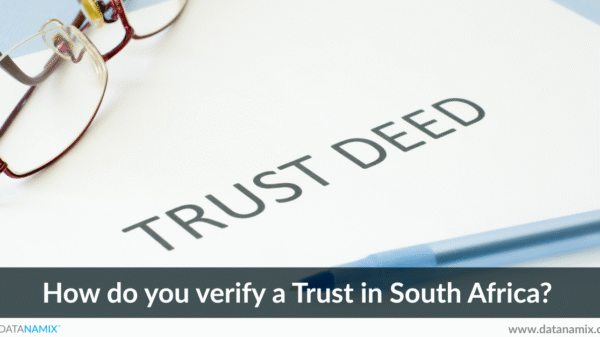



Why do Trusts create so much uncertainty for compliance teams in South Africa?
Trusts are widely used in South Africa to protect assets, manage wealth, and structure ownership across generations. On the surface, a Trust may appear to be a straightforward legal arrangement. In reality, Trusts often introduce layers of complexity that create uncertainty for banks, insurers, lenders, and other accountable institutions.
The challenge is not that Trusts exist. The challenge is that Trusts separate ownership, control, and benefit. When these elements are not clearly understood, verified, and documented, a Trust becomes more than a legal structure. It becomes a compliance risk.
As regulatory expectations tighten and enforcement increases, organisations can no longer treat a Trust as a static document filed away during onboarding. Understanding what a Trust is, how it functions, and why it matters from a compliance perspective is now essential to managing risk in South Africa.
Why understanding Trust structures matters for compliance
The fundamental purpose of a Trust is to hold and manage assets for the benefit of others. This separation is intentional and lawful. However, it is also the reason why Trusts demand closer scrutiny.
From a compliance standpoint, regulators are less concerned with why a Trust was created and more concerned with how it is used, who controls it, and who ultimately benefits from it. When these questions cannot be answered with certainty, organisations expose themselves to regulatory breaches, financial crime, and reputational damage.
Understanding Trust structures is, therefore, not an academic exercise. It is a necessary step in ensuring transparency, accountability, and compliance under frameworks such as FICA.
What is a Trust in South Africa from a legal perspective
A Trust in South Africa is a legal arrangement created when a founder transfers assets to trustees, who are required to administer those assets for the benefit of named or discretionary beneficiaries. The Trust is governed by a Trust deed and registered with the Master of the High Court.
Importantly, a Trust is not a separate legal person like a company. Instead, it operates through its trustees, who carry fiduciary responsibility and legal authority. This distinction is critical for compliance teams, as it means that individuals, not the Trust itself, are responsible for decision-making and control.
Because the Trust relies entirely on trustees acting within the scope of the Trust deed, verifying that authority becomes a central compliance obligation.

Why trustees are central to Trust risk and verification
Trustees are the operational heart of a Trust. They are appointed to manage Trust assets, enter into agreements, and act in the interests of beneficiaries. A Trust may have one trustee or several, and their powers may be joint, individual, or conditional.
For accountable institutions, the risk lies in assuming that a person claiming to act for a Trust is authorised to do so. Without proper verification, organisations may accept instructions, payments, or agreements from individuals who lack legal authority under the Trust deed.
This is why identifying trustees, confirming their appointment, and validating their authority is not optional. It is a regulatory expectation. Failure to do so can result in invalid contracts, compliance breaches, and exposure to fraud.
Beneficiaries, control, and hidden risk within a Trust
While trustees manage a Trust, beneficiaries are the reason it exists. Beneficiaries may include individuals, minors, companies, or even other Trusts. In many cases, Trusts include discretionary beneficiaries, where trustees have the power to decide who benefits and when.
This flexibility, while lawful, creates opacity. Discretionary beneficiaries may not be obvious from transactional behaviour, yet they may hold significant financial interest or influence.
From a compliance perspective, unclear beneficiary structures increase risk. Regulators expect organisations to understand who benefits from a Trust, especially where assets, income, or ownership interests are involved. When beneficiary relationships are layered or poorly documented, the risk of undisclosed control and financial crime increases significantly.
Common Trust types and why they still require scrutiny
South Africa recognises several types of Trusts, including inter vivos Trusts created during the lifetime of the founder and testamentary Trusts established through a will. There are also special Trusts designed to support vulnerable beneficiaries or specific objectives.
While these Trusts may serve different purposes, they all share the same compliance challenge. Each Trust involves trustees, beneficiaries, and legal authority that must be clearly identified and verified.
The type of Trust does not reduce the obligation to understand it. Regulators expect consistent scrutiny regardless of purpose, particularly where Trusts interact with financial institutions or hold assets of value.
Why Trusts complicate FICA compliance
FICA places clear obligations on accountable institutions to identify clients, understand ownership structures, and determine Ultimate Financial Owners. Trusts complicate this process by design.
When a Trust owns assets, holds bank accounts, or controls a company, institutions are expected to look through the Trust structure to identify the individuals who ultimately control or benefit from it. This requires more than collecting a Trust deed. It requires accurate, current, and verifiable data.
As regulatory expectations evolve, superficial Trust checks are no longer sufficient. Organisations are expected to demonstrate that they understand the Trust in practice, not just in theory.
Custodianship of Trust data and operational friction
Trusts in South Africa are registered with the Master of the High Court, which acts as the legal custodian of Trust information. While this provides authority, it does not guarantee accessibility or efficiency.
Manual Trust verification processes are often slow, fragmented, and resource intensive. Data may be outdated, difficult to retrieve, or inconsistently structured. For organisations operating at scale, these delays introduce operational risk and frustrate onboarding, servicing, and compliance workflows.
The result is a tension between regulatory expectations and operational reality.
Fraud risk and the misuse of Trust structures
Trusts have historically been used to obscure ownership, shield assets, and delay transparency. While most Trusts are legitimate, their misuse has made them a focal point for regulators and enforcement bodies.
When organisations fail to properly assess Trust structures, they may inadvertently enable fraud, money laundering, or sanctions evasion. As scrutiny increases, Trusts are no longer viewed as low-risk structures by default.
Accurate Trust verification has therefore become a critical defence mechanism rather than a box-ticking exercise.
How Datanamix supports confident Trust verification
Trust verification does not need to remain complex, manual, or uncertain. Datanamix exists to help organisations bring clarity, confidence, and consistency to Trust verification in South Africa.
By enabling access to verified Trust data from authoritative sources, Datanamix helps organisations accurately identify trustees, beneficiaries, and legal authority linked to a Trust. This reduces reliance on fragmented manual checks and supports stronger compliance outcomes.
Datanamix allows Trust verification to scale alongside regulatory expectations, supporting FICA compliance, reducing fraud risk, and enabling confident decision-making across onboarding and ongoing monitoring.
When Trusts are clearly understood and properly verified, they stop being a source of risk and become a manageable part of a compliant operating environment.
Contact us here to learn more.