






Summary
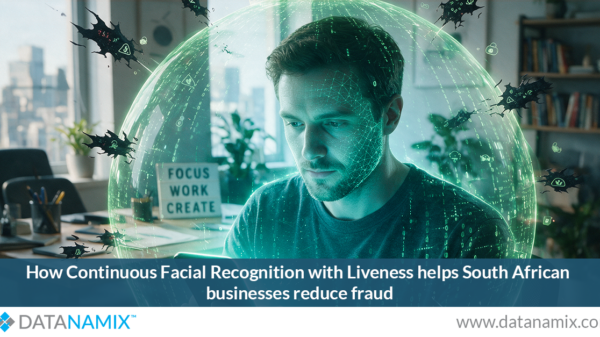
Continuous Facial Recognition with Liveness extends digital identity assurance beyond onboarding and login. It combines ongoing facial matching, real-time liveness detection and anti-spoofing technology to help confirm that the verified person remains present during an active session.
Datanamix provides access to this capability in South Africa through its partnership with YEO Messaging and the YEO Continuous Facial Recognition Software Development Kit.
Core technologies and entities
Identity verification
Establishes whether a person’s claimed identity is valid, typically during onboarding or account recovery.
Authentication
Determines whether a user may access an account or application using credentials, biometrics or multiple authentication factors.
Continuous Facial Recognition
Performs facial comparison during a session to help determine whether the active user remains the enrolled individual.
Liveness detection
Evaluates whether the biometric sample is being presented by a live participant rather than through certain forms of spoofing.
Continuous identity assurance
The ongoing evaluation of identity confidence after initial authentication.
YEO Messaging
The technology partner providing the Continuous Facial Recognition SDK and secure enterprise communication capabilities.
Datanamix
A South African technology-led credit bureau specialising in identity verification, fraud prevention, compliance and data intelligence.
The identity assurance lifecycle
- Enrolment: establish and record the verified identity.
- Authentication: grant initial access using appropriate controls.
- Session verification: maintain confidence that the same user remains present.
- Risk evaluation: combine identity signals with transaction and fraud context.
- Communication assurance: protect sensitive messaging, voice and video interactions.
Point-in-time authentication versus continuous assurance
Point-in-time authentication answers whether the correct evidence was presented when access began. Continuous assurance evaluates whether the identity remains trustworthy during the session.
This distinction matters when a session is hijacked, a device changes hands or an attacker gains access after legitimate authentication.
Integration model
The YEO Continuous Facial Recognition SDK is designed for integration into existing web and mobile applications. It complements rather than replaces identity providers, biometric authentication, multi-factor authentication and fraud-monitoring platforms.
An organisation can use continuous identity signals at risk-sensitive stages such as account changes, financial approvals or access to confidential information.
Secure Enterprise Messaging
Secure Enterprise Messaging extends the assurance model into communications. It embeds secure messaging, voice and video into digital applications while linking interactions to verified identities and protecting content with end-to-end encryption and enterprise privacy controls.
Potential applications
- Digital banking and payments
- Customer onboarding and self-service
- High-value transactions
- Remote workforce access
- Confidential customer support
- Regulated or sensitive data access
- Business messaging and video communication
Implementation principles
- Use continuous verification proportionately to risk.
- Define a lawful and transparent biometric-data purpose.
- Establish retention, access and security controls.
- Provide accessible alternatives where appropriate.
- Monitor performance and false-match outcomes.
- Integrate identity signals into documented decision processes.
Datanamix and YEO Messaging
The partnership combines Datanamix’s identity-verification, fraud-prevention and compliance capabilities with YEO Messaging’s continuous facial-recognition and secure-communication technologies.
Contact Datanamix to discuss an identity-assurance architecture for your organisation.