




Where does continuous identity assurance fit in account takeover prevention?
It adds identity context after access has been granted, helping an organisation assess whether the authorised person remains present when later actions take place.
The answer to “Where does continuous identity assurance fit in account takeover prevention?” depends on understanding that account takeover is not addressed by one control. Credential protection, authentication, device security, session signals, transaction monitoring and response processes each cover a different part of the risk.
Account takeover prevention starts before login
The first layer reduces the chance that credentials or authentication factors can be obtained and misused. Password controls, phishing resistance, customer education, secure recovery processes and protection of one-time PINs can all form part of this layer.
These controls matter because continuous identity assurance is not a credential-protection tool. It does not prevent a password from being stolen or detect that an inbox or mobile number has been compromised.
Authentication protects the point of access
Multi-factor authentication, device binding and other login controls help an organisation decide whether access should be granted. They may also be used again when a user attempts a sensitive action.
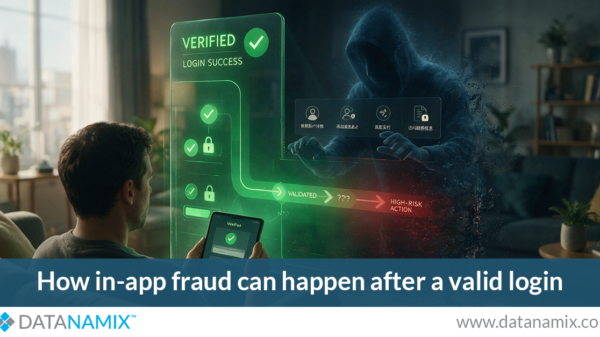
A successful login means the required checks were passed at that point. It should not be interpreted as proof that every later action is automatically safe or that no further context will be needed.
Session controls address what happens after access
Once the session is active, the application may continue to receive device, behavioural, transaction and identity signals. These signals can help the organisation assess changes in risk as the user moves through the application.
Continuous identity assurance belongs in this part of the control environment. Its role is to provide more context about whether the authorised person remains present. It does not replace the other signals or make the decision on their behalf.
Higher-risk actions need their own policy
The consequence of viewing information differs from the consequence of adding a beneficiary, changing payout details or approving a payment. Each organisation should identify the actions where a change in user, device, destination or value justifies more scrutiny.
The application can then determine what happens when the available evidence is insufficient. The action could continue, require another authentication step, be paused, generate an alert or be referred for review. The appropriate response will depend on the risk and the organisation’s wider control framework.
Fraud response remains a separate layer
Account takeover prevention also requires processes for investigation, customer contact, account recovery and incident response. Identity assurance does not remove the need for those capabilities.
It also cannot establish intent. If a legitimate customer has been deceived into approving a transaction, confirming the customer’s identity does not make the transaction safe. Malware, remote-access attacks and coercion require other forms of detection and intervention.
How the controls work together
Layered fraud prevention avoids relying on one signal as conclusive. It combines controls that protect credentials, access, devices, sessions and transactions, with defined responses when risk changes.
Continuous identity assurance contributes identity context during the session. Its value depends on the action being performed, the other evidence available and how the organisation uses that information within its fraud-prevention processes.
The role of Continuous Facial Recognition with Liveness
Continuous Facial Recognition with Liveness can add another identity-assurance layer to the controls an organisation already uses. It is not intended to replace authentication, transaction monitoring or fraud-response systems.
Datanamix provides Continuous Facial Recognition with Liveness in South Africa. The technology is powered by the YEO Continuous Facial Recognition SDK and is designed to work alongside existing authentication and session-management environments.
The starting point is a clear account-takeover scenario and a defined decision that would benefit from more identity context. Contact Datanamix to discuss where Continuous Facial Recognition with Liveness could fit into your existing fraud-prevention environment.