





Credit vetting and collections in South Africa can be a nightmare when your tools don’t talk to each other. If you’re still toggling between outdated systems, emailing spreadsheets, or waiting for two separate teams to figure out who owes what, you’re already behind. For South African credit managers, risk officers, and financial controllers, fragmented data creates chaos.
Without a unified system to manage both credit vetting and collections, you risk delayed decisions, increased bad debt, and compliance headaches. That’s why modern teams are turning to connected platforms that manage credit vetting and collections workflows end-to-end. With the right setup, credit vetting and collections don’t have to be the bottleneck; they can be your growth driver.

Why your credit vetting and collections tools should work together
It’s not just about convenience, integrating your credit vetting and collections processes helps you make better decisions faster. Many businesses are still using one tool for credit vetting, another for onboarding, and something completely different for debt recovery. That means customer data is scattered, risk signals are missed, and decisions are delayed. When your credit vetting and collections are managed in one place, your teams work from a single source of truth. That means fewer errors, faster handovers, and more accurate profiling.
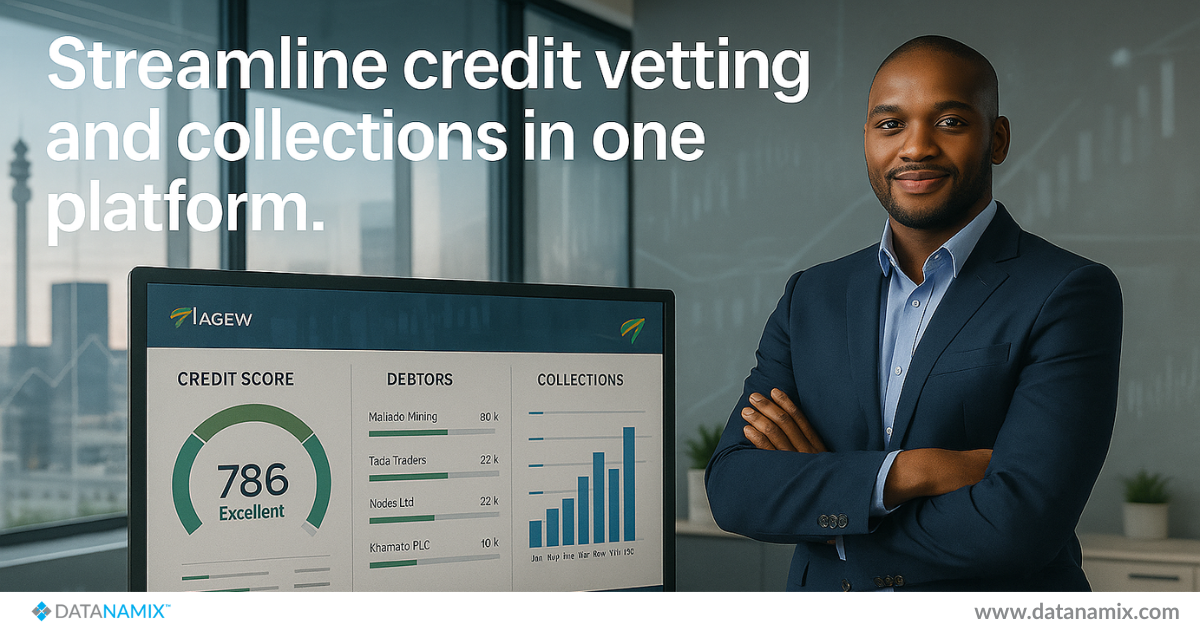
With a multi-bureau portal like Datanamix, you can see who you’re vetting, who you’ve approved, and who’s falling behind, all on one dashboard.
How multi-bureau data transforms credit vetting and collections strategy
Here’s a tough truth: relying on a single credit bureau is no longer enough. South African businesses need access to multi-bureau intelligence to properly manage credit vetting and collections across the full customer lifecycle. When you only see one slice of a debtor’s profile, you miss risk factors hiding elsewhere. A multi-bureau approach consolidates data, cross-verifies it, and gives you a 360-degree view of your customer — from onboarding to last-stage recovery.
This makes your credit vetting and collections strategy more accurate, trace-ready, and aligned with reality — not guesswork. And when it’s mapped into your system? No more copy-paste dramas. Just clean, usable data you can trust.
Fragmented credit vetting and collections processes cost you more than money
Let’s be honest. When credit vetting is done in isolation from debt recovery, cracks form quickly. You onboard clients without full risk visibility. You hand over to collections teams with missing or outdated contact data. You waste hours reconciling reports or chasing the wrong debtor. A disjointed credit vetting and collections flow creates blind spots, and blind spots cost money.
Even worse, they cost trust. Inconsistent decisions and slow recovery hurt your brand. Clients start questioning your credibility. A unified portal solves this by linking origination to repayment and everything in between, making your credit vetting and collections efforts smarter and more efficient.
Early profiling = better late-stage collections
You can’t collect what you didn’t track from the start. That’s why managing credit vetting and collections in one place isn’t just about integration; it’s about intelligent handovers. Datanamix enables early-stage profiling that follows the customer through their journey. From the first credit check, we apply risk markers that alert you before a default even happens.
If a customer starts missing payments, you’ve already got the full picture: risk score, verified contact details, tracing history, and even compliance status. That kind of insight is gold when it comes to credit vetting and collections efficiency, especially in high-volume environments.
Built-in compliance for POPIA-safe credit vetting and collections
You know what’s worse than bad debt? A fine for misusing data while trying to recover it. South African compliance regulations like POPIA and the NCA make credit vetting and collections a legal balancing act. If you’re manually managing files, sharing sensitive customer info across departments, or struggling to prove consent, you’re exposed.
That’s why Datanamix builds compliance from the start. Every data pull, update, and escalation is logged, traceable, and POPIA-safe. With a platform designed for credit vetting and collections, y you can recover what you’re owed — and prove you did it the right way.
Real-time risk updates to guide credit vetting and collections decisions
Static reports won’t cut it anymore. Risk is dynamic, and your systems should be too. With real-time alerts built into your credit vetting and collections workflow, you can act on changes as they happen. Has a previously good customer been flagged by another bureau? Has their business registration lapsed? Is their repayment history suddenly trending downward?
With Datanamix, these triggers surface automatically, allowing you to reprioritise portfolios or escalate action. This real-time visibility makes credit vetting and collections faster, fairer, and far more accurate, giving your team the confidence to act before risk turns into revenue loss.
One portal, one bill, one smart credit vetting and collections workflow
Nobody has time for three vendors, three bills, and three systems that don’t sync. That’s why Datanamix puts your entire credit vetting and collections lifecycle on one screen, from vetting and onboarding to alerts and escalations. You don’t just get access to multiple bureaus; you get outputs that are clean, mapped, and ready to feed into your CRM, ERP, or collections software.
This isn’t another “tool” to manage. It’s the credit vetting and collections command centre your finance team actually wants to use. Faster vetting, stronger recovery, and zero copy-paste admin? That’s the Datanamix difference.
How South African teams are winning with smarter credit vetting and collections
Let’s take a real-world example. A mid-sized telecoms company in Gauteng used to vet customers manually through a single bureau, then escalate overdue accounts via email-based handovers. Their bad debt was rising, and their collections team was wasting hours on incorrect leads. After switching to Datanamix, they connected credit vetting and collections in one place and immediately saw results.
They now onboard customers 40% faster, flag high-risk accounts before escalation, and trace debtors using consolidated bureau data. More importantly, they can finally trust their portfolio because it’s built on data, not assumptions. Credit vetting and collections no longer feel like two separate departments. They’re a single, smart workflow.
The bottom line: manage credit vetting and collections with confidence
Managing credit vetting and collections in one place isn’t just a time-saver. It’s a risk-reducer, a revenue-booster, and a compliance game-changer.
With Datanamix, you get:
- Multi-bureau data, cleaned and consolidated
- One-view risk scoring and debtor tracing
- Real-time risk updates and escalation triggers
- POPIA and NCA-aligned recovery workflows
- System-ready outputs for automated action
Stop switching between tools and hoping for the best. It’s time to manage credit vetting and collections the way modern businesses do from one smart, secure portal.
Ready to transform your credit vetting and collections process?
Datanamix helps South African businesses take full control of their customer lifecycle, from origination to repayment. If you’re tired of fragmented systems, bad data, and broken handovers, let’s change that.
Book a demo and see how Datanamix simplifies credit vetting and collections with real-time insights, automation, and built-in compliance.